The Other Side of Dr. Xeno's Brain

It's me, Dr. Xeno. Here are lecture notes and ideas for my work teaching physical and cognitive development across the lifespan (HDEV 3101) at the Department of Human Development at CSU, East Bay. This content is often referred to as mind-brain, mind body connection, brain and behavior; but it is really about the knowledge derived from the related fields of neurology, neuropsychology, neuroscience and cognitive science. Sometimes I just write about my kids or bike racing. Feel free to comment!

Monday, October 17, 2011

Emotional Processing

How Ya Feelin'?! (HDEV 3101 Week 4, 2011)
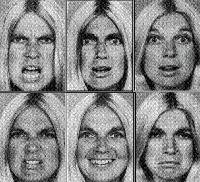

The above are the SIX classic and universal expressions associated with the basic, or primary, human emotions. Many thanks for Paul Ekman and his socio-emotional-behavioral research team. Assuming you are human and have vision, you should recognize each of these "affects", or expressions of emotions - and you should also be able to name them. Depending on your culture, language or experience, you may used different words to label them, or may express them under different conditions, but they are indeed expressed and perceived consistently across cultures.


Wikipedia says, "Paul Ekman is a Psychologist who has been the pioneer in the study of emotions and their relation to facial expressions. He is considered one of the 100 most eminent psychologists of the twentieth century. Ekman takes an evolutionary perspective, in that the development of human traits and states over time is the background to his research." Ekman found that facial expressions of emotion are not culturally determined but are universal to all human cultures and suggesting they are biological in origin (innate?). Ekman also discovered microexpressions which are a brief facial expression that last less than a quarter of a second. In his research called the Diogenes Project, Paul Ekman found that these tiny movements often can expose lying (seen "Lie To ME" on TV?). Paul Ekman is also the founder of The Facial Action Coding System (FACS) which details the exact muscular-physical expressions of emotions which is useful to psychologists and animators.
So, how ya feelin'?
Much of emotion is communicated non-verbally - both it's expression and perception. Expressed emotion is 'affect', while experiencing emotion internally is 'mood'. Different mood states involve different patterns of activation in both physical and cognitive domains. "Flat affect" indicates a lack of emotional expression. Maybe on purpose (like a poker face) or reflect low energy (fatigue) or low mood (like in major depressive episodes). Adding emotion (or meaning) to our spoken language with varying inflection is known as "prosody." This aspect of language, and emotional processing in general seems to be one of the strengths of the right hemisphere. However, there are known bilateral structures and pathways specializing in emotion and I will name only the amygdala; a limbic structure, sub-cortical (diencephalon) with some tight connections with memory structures such as the hippocampus.

"Feeling" or "feelings" is another problematic term for me - it is probably more accurate to use sensation(s), perception(s), or emotion(s). "Feeling" is usually assumed to mean emotional state - "how or what are you feeling?" is an attempt to tap into someones emotional condition, not their sensory-perceptual experience. My point is picky I suppose, but just clarify what exactly it is that you are "feeling" - it's a verb - so, "I am feeling angry" suits me fine; so does, "I am feeling something poke me". Emotional processing is just another example of information processing; on the other hand, some have argued that ALL information processing IS emotional. Or put another way, you are always feeling SOME emotion, and that pattern of activation flavors your cognitive processing. Perceptions, memories, decision making are ALL effected by emotion (and vice versa), so the two are nearly impossible to separate.

Kenneth Dodge suggests that, "emotion is the energy that drives, organizes, amplifies and attenuates cognitive activity." "Feelings" would be a noun - a thing - the things that people "feel". So again, please notice how general & vague that would be. Much like we use "see" for think, we use "feel" for emotion.

Most theories of emotion include some common themes: emotion involves complex layers of processes that are in constant interaction with the environment. Emotional processing involves BOTH cognitive AND physical process.

Basic Phases/Timing of Emotion/Emotional Processing
Initial Orientation/Awareness - we orient toward a stimulus, early activation, focusing of attention, first 100 ms.

Appraisal - what did that stimulus mean? Additional perceptual info on the stimulus tells us more. 100-300 ms.

Arousal, mental and physical (coupled with cognitive appraisal, this gives us experienced emotion, or "feeling"). This represents our full awareness of both the perceptual process and emotional process, now packaged into what we might refer to as a "feeling", or better yet, an "emotion". 350+ ms.

Organizing Emotions
Differential and Categorical - most simple category is the emotional valence. (positive vs. negative emotions).
Positive emotions are not "good", they are inherently rewarding, we'd like to feel more of them.
Negative emotions are not "bad", are not rewarding, we'd like to feel less of them, or feel them less intensely.

Primary Emotions - more highly categorized, and yet, basic emotions such as: sadness, fear, joy, anger, disgust or surprise.
Some emotions are differentiated by their complexity, we often experience a blend of two or more basic emotions. (Such as the term "emotional complex")

Development of emotional maturity is largely about regulating emotional responsiveness. But also may involve more full awareness and acceptance of more complicated emotions as well as recognizing and respecting the emotional states of others. (Recall the types of "change".)


Mood states?
The Profile of Mood States
Mood disorders?
These are actual diagnoses, not just "feelings".

Labels: ,

Tuesday, October 11, 2011

Movement & Control


Regulation
The brain must not only deal with the mental side of life, but with maintaining life itself through regulation. The brain has automated regulatory control over it's own activation/alertness as well as specific bodily functions such as heart rate, breathing and temperature. Eating, drinking, sleeping and reproduction require some voluntary behavior on our part, but are largely influenced or at least maintained by non-conscious regulatory control. Much of this regulatory control is exerted through the neuroendocrine system utilizing various feedback mechanisms (see Carter, pp. 112-113).

Motor control
The other main category of control the brain attends to is voluntary movement. Movement of the body can be organized a number of way and one way to distinguish between those that are "controlled", under conscious control, versus those that are "automated" which are no longer under conscious control. They no longer demand very much attention or processing resources and may operate without our awareness (example of driving). However, these are not really "automatic" or "UNconcious" as Carter writes (p. 114), I think those terms should be reserved for truly REFLEXIVE behavior that will take place even IF unconscious.


Reflex Action:  Strictly speaking, we mean "spinal reflex", can you think of any more complex behavior that you do "reflexively"? (Motor memory? Muscle memory. Implicit memory/learning system foreshadowing Learning & Memory Unit). Motor control involves some feedback from the body and environment, so motor control work in conjunction with sensation and perception.

Planning and Executing Movement (Carter, pp. 114-1119)
Meet the frontal lobes. Pre-motor cortex for planning. Lateral coticospinal tract begins at the primary motor cortex carrying direct voluntary control of specific muscles. Then tract slides through the thalamus to integrate with sensory world, then go deeper and meet the sub-cortical nuclei of the basal ganglia to amplify or suppress unwanted movement. Finally, make it neat: the cerebellum infuses a sense of timing and coordination into your ongoing movements. Final output is down though the spinal cord tracking region wise to the correct motor spinal root where it exits onto it's nerve in the PNS.

Other simpler motor-oriented pathways too, largley UNconcious... example vestibulospinal tract (Wikipedia entry).

Labels:

Sensation & Perception


Do you see what I mean?

"Vision", or seeing, involves more than just gathering images with the eye. Sensation is the process of bringing information into the brain for evaluation while PERCEPTION is that process of making sense, or meaning out of the raw sensory data. Sensory organs and their first synapses are akin to the hardware of a computer, while more elaborate perceptual processing could be seen as software that gets programmed and customized over time.

Effective perceptional processing reveals the capacity of the nervous to learn - and perception is a learned process, which is to say our "percepts" are based on past experience. Some may refer to these as "schema" which resemble our tendency to organize incoming raw sensory info into meaning units. The units can be simple, nearly sub-conscious (e.g., movement, color) relating to one perceptual field. But schema may be complex subjective concepts (e.g., beauty, slavery) that are interpretations of simpler perceptual input. "Schemata" may refer to the overall inventory of schema you have and sometimes schemata includes the process whereby we create, store and retrieve and perceive them. But if we don't develop the schema for something, we can't really "see" it - it escapes our perception. Story of villagers asked to describe a scene in a movie. Eskimos and all those words for snow.

Both sensation and perception rely on (or reveal?) the plasticity of the nervous system, but also rely on the integrity of their respective pathways to ensure. A simple act of recognition requires matching a percept in the present with one stored in the past.

Perceptual Differences
Our perceptions are effected by SO many factors such as early environment, culture, health, etc.

Attention, or our ability to concentrate mental energies on specific cognitive operations such as perception, is critical. Something so simple as counting a moving object involves so many mental process and region of the nervous system:


You will often see exactly what you are looking for. Or you see "see" what you "set". In Simons and Chambris' (1998) laboratory study of the invisible gorilla video, nearly half the participants who correctly counted the number of passes missed the gorilla.

These tools for perception that are essential for making any kind of meaning out of world are also limiting what we can "see". So, please be aware that your perceptions are YOUR reality, but not THE reality.

Labels:

Tuesday, October 04, 2011

Week 2: Structure of the Nervous System

[photo of Logan, credit www.borterwagner.com]

Week 2: Structure of the Nervous System, relates to pp. 36-73 in The Human Brain Book. I think the best 2 pages on overall structure are pp. 40-41, and the best neuron pictures and info are pp. 68-73.

The nervous system in all animals essentially serve the same basic functions - body control and registration of sensory input from the outside world. Yes, some body control is in response to input and some input leads to complex subjective experience so this is no simple task! But let's leave the "thinking" the brain associated with for later. How does the brain do this? The specialized function of neurons allows them to transmit signals between each other - the signals are chemicals called neurotranmitters, but the overall process is "electrochemical".

The hot-linked text below will take you to the relevant section of the GetBodySmart tutorial. These are optional, but I will use some for visual support and additional explanation.

The nervous system is made of literally TRILLIONS of TWO types of cells:
neurons - actively communicate by synaptic connections (electro-chemical process)
glial cells - support cells, protect and increase speed of communication (myelin sheath)110,000,000,000 neurons and about 50x that number of neuroglia. Also tend to be larger than neurons.
(50x110,000,000,000) + 110,000,000,000 = total cells in the NS.
5,610,000,000,000 or 5.6 trillion cells

Organ system hierarchy:
System/organ/tissue/cells/molecules/atoms
Example of the nervous system:
NS/brain, spinal cord?/nuclei (gray matter) and pathways (white matter) make up networks/neurons and glia/cytoplasmic parts and products of neurons, most unique and important: neurotransmitters...

[Cardiovascular/heart, vasculature? and blood?/smooth muscle and blood/muscle fibers and blood cells (white, red)]

Traditional 3 parts/DIVISONS of the Nervous System:

CNS = central nervous system (intensely protected by bone, spinal fluid, glia)
brain - the central processing unit
spinal cord - pathways going up and down, as well as reflexes ('u-turns', 2 neuron reflex)

PNS = peripheral n.s.; mostly enters or exits holes in the spinal cord or vertebrae
carries information from receptors in the body to the spinal and then UP to braincarries information coming DOWN spinal cord to effectors in the body (muscles, glands)specialized cranial nerves (12 total) enter or exit holes in the cranium, not the spinal cord

ANS = autonomic n.s.; functional system made up portions of both CNS & PNS, 'automated' (non-conscious) control of body:
Sympathetic branch: activation/arousal, flight or flight response, emotion
Parasympathetic branch: recuperation, relaxation, rejuvination

4th? "Somatic nervous system" - carries voluntary/conscious control and sensory information we perceive

Divisions of the Brain
No one system for this.... I enjoy the theoretical and integrative framework of the "triune brain" hypothesis by Paul MacLean. His "3 brains in 1", represents the three major evolutionary steps leading to the modern human brain structure and function; reptile brain, mammal brain, primate brain. JUST a model for understanding, not "real".
and the Human Brain Book (Carter) shuffles around.
Each division is made up of a number of specific neuroanatomical structures with specific functions.

Often, brain divisions are presented from the bottom-up... "lower" functions and structures first. Like triune brain. Good if you can learn to see from both perspectives as the NS provides both upward and downward messages. Any complex human behavior will involve sensory signals that go "up" and control signals that go "down".

brainstem - basic body functions (medulla oblonglata, pons, midbrain) - directly above spinal cord
cerebellum - motor coordination & motor learning, posture, means "little brain".
diencephalon - subcortical forebrain - emotion, motivation, awareness ("Limbic System" of thalamus, etc.)
telencephalon - 'forebrain' - cerebrum - cerebral cortex - outer layer, newest, conscious thought (cognition)

THE CORTEX will be described in greater detail as we address the functions of the four lobes in the coming weeks

Organizational Features of the Cerebrum (many will re-appear this quarter):
Right and left hemispheres of the cerebrum/telencephalon
Both symmetrical AND asymmetrical
Four lobes and their boundaries
White matter and gray matter
Primary or secondary cortex
Sensory mapping for senses, body mapping ("homunculus") for motor control
"Decussation", contra-lateral representation, or crossing-over of pathways from one side to the other

Labels: , , , ,

Tuesday, September 27, 2011

Intro and Overview of HDEV 3101


"Week 1" for HDEV 3101
Outline below includes relevant concepts. (i.e., 'quizable', or important for building upon later)

A psychological perspective on physical and cognitive development across the life span.

Definition of psychology?

Definition(s) of 'human development'? (my favorites; 1) a process, 2) a field of study, a certain perspective or academic approach, 3) and academic department housed in CLASS at CSUEB).

What are humans? Animals - sub-species (homo sapiens sapiens); each human is an organism, made of organ systems/organs/tissues/cells.

What conceptual categories of change can we observe:
growth
development
maturation
(transformation)

QuickTime brain growth

What is neuropsychology?

Basic functions of the brain/nervous system?
Branches of neuropsychology - main distinction is EXPERIMENTAL vs. CLINICAL

Two major conceptual issues arise:
- An inference is almost always required when correlating behavior with brain
-The mind-body question/problem (monism, dualism and lots of sub-types)
Emergent materialism; in particular, we a complex system, a 'biosystem', similar to an ecosystem.

-a 3rd issue is determinism by way of genetics/"nature", but should NOT lose sight of the fact the the brain develops in a context - an environment that "nurtures" by way of stimulation.

Five features of the historical background of neuropsychology:
1. Ancient record, archeological evidence
2. Classical Greece, philosophical but also medical foundation
3. Phrenology (1830), reading the bumps
4. Localization theory - Broca's area (1860).
Versus equipotentiality
5. Interactionist theory (Jackson) - sort of how we ended up with a 'biosystem' concept

Related - COGNITIVE SCIENCE and information processing theory - views the mind-brain as a machine, specifically a computing device. Will end up suing this information processing perspective often during the quarter. But keep in mind, you are NOT a machine! you are an animal!

Labels:

Thursday, November 19, 2009

Growing a brain, inside a body (week 9)


Humans change - they grow, develop and mature. Lots of ways to look at this; measure is quantitatively, view it qualitatively or consider it's transformative nature. However, it clearly rests upon a biological entity (the human itself). It is fascinating, because it is us and those around us. (
Growth, development and maturation definitions; p. 15, Barry Bogin, Patterns of Human Growth)

Human development (biology) Wikipedia.org article with mega-hypertext
Especially note the stages/phases of physical growth. Alternatively, consider simply the age of the organism. Age often reveals the stage of development and/or functional capacity. But individual variability can be great.
Seen a fetus lately?
Motor Milestones
Brain Growth
Major Events in Neural Development
Important terms, semi-chronological: proliferation (increase in number), migration (movement/organization), connection (preliminary and ongoing), pruning (normal early death of neurons not forming significant/useful connections), mylenation (temporal lobes not until ages 2-4, frontal lobes not until late 20s).


The only way to pack the incredible human cortex into our skulls is to fold it in upon itself - this is what gives the cortex is wrinkled look. This allows greater surface area in a smaller volume. The sulci are valleys and the gyri are the bumps or hills. Tracking the development of the folding process may give us an early indication of abnormal brain growth & development. See the brief report in the NCRR Reporter.
See this link for some physical growth charts by the WHO.

Marilyn Diamond (UC Berkeley), Godmother of lifelong cortical plasticity - or brain enrichment. Studied enriched environments effects on rat brain, behavior, health. Amazing stuff.
Response of the brain to enrichment (1997).


Labels:

Thursday, November 12, 2009

Integration and States of Consciousness


Integration
One of the mind-brain's key features is it's ability to interconnect a range of processes within it's present time frame as well as interconnecting activities and content across time. We experience this as 'spatiotemporal integration.' Much brain tissue and activity is about this type of 'association' of information rather than specific or direct sensory or motor processing (side note on association cortex). Lack of integration leads to a lack of cohesiveness in our mental/cognitive worlds/experiences. While specific (modular) cognitive activities can lead to or disrupt integrative experience, holistic (molar) operations such as language, consciousness, emotional processing (or powerful retrieval experiences) are more likely to set the tone for integration or cohesive mental experience. When successful, this is a seamless, tacit process. That is, we are unaware of all the sub-processing and patterns of activation, we experience it as a whole. Our consciousness.

What needs to be integrated?
1. Various cognitive activities (content and process); orientation, attention, sensation-perception, visuospatial function, cognitive mapping, memory function, language processing, prosody, emotion, planning and other executive functions. AND basic body control/monitoring.
2. Various levels of brain functions (triune brain; vertical integration in columns)
3. Hemispheres of the brain (lateral integration; corpus callosum)

Evidence/pathways to integration
1. Self - sense of self may result from the recursive nature of ALL neural processing. It's always happening to YOUR neural pathways and the activity shifts always resemble to ones before and after closely. It's a placeholder, or perhaps a canvas, or a major landmark by which to measure and compare all experience.

2. Theory of mind - requires some meta-cogition and meta-memory. What we know about our own cognitive/memory function. Building a theory of mind requires that we have the ability to place ourselves in their position and imagine what they would hear/feel/etc.

3. Response flexibility - consider alternative responses and select the best suited response set. Opposite is 'stimulus bound' behavior. This may be ultimate executive function. Intelligence? Problem solving?

4. Narrative - sequential descriptions of people and events that condense numerous experiences in generalizations and contrasting stories. Narrative process attempts to make meaning of the world and one's own mind on it's various states.

What is lack of integration?
Disintegration? Lack of cohesive experience; incoherent. Lack of the above 4 items? Some terms for lack of various functions:
Dementia
Amentia
Amnesia
Aphasia
Agnosia
Apraxia
Psychopathological dissociation - shizophrenia (split or broken mind) vs. multiple personality disorder.

Can result from structural or functional brain problems or simply psychogenic states with no know organic cause.

State(s) of consciousness
OVERALL pattern of mind-brain activation; includes, but more than simply being conscious or unconscious or "the subconscious" mind. These states are fluctuating, however, any pattern of activation is likely to recur; and a recurring pattern of activation may become a persisting TRAIT rather than simply a state. The state reflects both the type of processing going on (or degrees of various processes) AND the content being processed. Many things can affect the overall pattern of activation; keep in mind you have some control over this. SO, be mindful over whatever pattern of activation you allow - because it will recur or possibly even persist and may not go away (or at least not easily).

Labels:

Thursday, November 05, 2009

Brain Damage, Neurodegeneration and Dementia, Oh My!

Week 8?/Chapter 8 (plus Dementia Max PowerPoint slides)

Non-cortical (sub-cortical?) conditions:
A lot of these are predominantly movement/motor disorders with or without cognitive impairment. ALS (Lou Gherig's Disease) is exclusively motor and is not discussed here.

Multiple sclerosis (MS) - demyelinating disease (auto-immune disorder?)
  • wide ranges of symptoms depending on central (including cortex) or peripheral
  • relapsing-remitting or chronic progressive form; even CP form can begin as RR
  • variable signs & symptoms as well as clinical course
  • limb weakness, ataxia, sensory loss, etc.
Parkinson's Disease:
Parkinson (1817) described the syndome, also known as "paralysis agitans". Destruction of substantia nigra of the basal ganglia and presence of Lewy bodies; subcortical/nonvoluntary motor control, smoothing. Parkisonism is similar signs & symptoms but from another cause.
  • Parkinson's shuffle - stooped, small steps, straight-lines, etc.
  • slow, including speech (and hyphonic)
  • rigid, cogwheeling, TREMO at rest
  • cognition? depends, at the very least, it is also slowed
  • responds to dopamine therapy (l-dopa)
Huntington's Disease/Chorea:
writhing, genetic. More rare. Basal ganglia also, but striatum. Personality and cognitive changes.

Profound brain injury, coma, locked in syndrome.

DEMENTIA?

Labels:

Thursday, October 29, 2009

Language

Language and Communication


[Similar images on p. 146, Carter] Catscan image credit, John norseen, George Washington University. Reveals differential patterns of functional brain activation. Shown are neural activation patterns associated with four different operations within the realm of verbal processing. Shown is the left hemisphere and most people are left hemisphere dominant for language processing.


Hearing words show temporal cortex activation (location of auditory cortex); seeing words shows occipital cortex activation (visual cortex); speaking words shows frontal (motor cortex); and generating words shows prefrontal cortex activation (uhhhh.... executive functions, coming up with new ideas, response flexibility, following rules).


Conceptual over view, cognitive science:

LOCALIZATION of Function: specific regions (locations) of the brain have specific functions. Damage to that region leads to impairment or loss of specific functions. In the absence of damage, individuals with varying degrees of efficiency and/or interconnnectivity in that region may show varying degrees of proficiency in it's specific function. Taken to an extreme, this concept suggests MODULARITY wherein independent modules of the mind-brain perform specific and unique processing on particular forms of information.

DISTRIBUTION of Function: any function or process of the mind-brain will involve multiple regions (either nuclei or pathways) distributed throughout the nervous system. Therefore, the location is not as important as the overall mass action of the brain. Taken a bit to an extreme suggests the concept of EQUIPOTENTIALITY wherein any brain region can be organized or re-organized to perform any task. Recovery of Function is also possible to an extent we once did not realize.


Tha Main areas: BROCA'S AREA, frontal, and WERNICKE'S AREA, temporal.

Varieties of APHASIA (language disorder; Carter, p. 147):
1. Broca's aphasia - motor, nonfluent, expressive
2. Wernicke's aphasia - sensory, receptive
3. Conduction aphasia - central
4. Anomic aphasia - anomia, naming items
5. Transcortical motor aphasia
6. Transcortical sensory aphasia


Review of the "A"s so far:


Amnesia, Agnosia, Aphasia, Anomia, Ataxia (motor), Apraxia (motor-conceptual)

Labels:

Thursday, October 22, 2009

Parietal and Occipital Lobes

Week 5: Parietal Lobes (Chap 5) and Occipital Lobes (Chap 6)

Parietal Lobes (Chap 5)

Anatomical items: anterior and posterior regions

1. anterior region - foreward most/anterior border is the posterior central sulcus/gyrus
  • primary somatosensory cortex (sensory strip)
  • secondary somatosensory cortex
  • tactile perception
  • body sense
2. posterior region - no clear/hard borders
  • ALL tertiary cortex
  • spatial orientation/spatial neglect
  • some cases of visual agnosia
  • APRAXIA; disorder of practical/purposeful/intentional motor behavior
  • cross-modal integration/language (PTO, remember?)

Occipital Lobes (Chap 6) - the visual perception lobes
  • primary - basic visual functions
  • secondary - visual perceptual functions
  • tertiary - higher order perception and inter-sensory integration (PTO, remember?)

Labels:

Tuesday, October 20, 2009

Temporal Lobes

Week 4/Chapter 4: The Temporal Lobes (and memory)

Anatomical considerations:
Temporal lobe is like a peninsula, or the thumb in the hand brain
Lateral portion - outer surface; neocortex = new cortex (thumb nail side)
Mesial portion - inner or middle surface; paleocortex = old cortex (thumb pad side)
Medial temporal lobe - deep structures, not actually 'sub'cortical, because it is like a cortical roll up. Basically, the hippocampus.

7 Functions of the temporal lobes? (see p. 92 for list, and chapter for details)
Heavily involved in memory and perceptual processes.

1. Audition; primary, secondary and tertiary auditory cortical zones in temporal lobe
2. Vision (chap 6 also, Occipital Lobes)
3. Language (chap 7 also)
4. Attention
5. Cross-modal integration
6. Memory - see Memory Max powerpoint at Bb
7. Personality

Cases studies in amnestic disorders involving temporal lobes. The "Hollywood Amnesia" syndrome is usually unrealistic.

Labels:

Monday, October 05, 2009

Frontal Lobes


Week 3/Chapter 3: terms and topics for the frontal lobes

Executive functions?
Personality? Humanness?
Intelligence? Methodological issues: comparing lesions; quantitative (IQ, Category Test) versus qualitative changes (abstract and concrete thought).

Frontal lobe has a range of specific functions associated with various divisions and features:
  1. Motor and premotor cortex - voluntary motor control and planning
  2. Broca's area - on motor/premotor cortex; control of speech, if damaged, "motor aphasia"
  3. Prefrontal cortex - a bit more complex; social behavior? intellegence?
  4. Orbital-frontal region (secondary taste & smell cortex, reward/pleasure of tastes and odors)
  5. Olfactory bulb/nerve - "primary olfactory cortex", frontal lobes are on top of it

Labels:

Tuesday, December 02, 2008

Integration


One of the mind-brain's key features is it's ability to interconnect a range of processes within it's present time frame as well as interconnecting activities and content across time. We experience this as 'spatiotemporal integration.' Much brain tissue and activity is about this type of 'association' of information rather than specific or direct sensory or motor processing. Lack of integration leads to a lack of cohesiveness in our mental/cognitive worlds/experiences. While specific (modular) cognitive activities can lead or disrupt integrative experience, holistic (molar) operations such as consciousness, emotional processing (or powerful retrieval experiences) are more likely to set the tone for integration or cohesive mental experience. When successful, this is a seamless, tacit process.

What needs to be integrated?
1. Various cognitive activities (content and process); orientation, attention, sensation-perception, visuospatial function, cognitive mapping, memory function, language processing, prosody, emotion, planning and other executive functions. AND basic body control/monitoring.
2. Various levels of brain functions (triune brain; vertical integration in columns)
3. Hemispheres of the brain (lateral integration; corpus callosum)

Evidence/pathways to integration
1. Self; sense of self may result from the recursive nature of ALL neural processing. It's always happening to YOUR neural pathways and the activity shifts always resemble to ones before and after closely. It's a placeholder, or perhaps a canvas, or a major landmark by which to measure and compare all experience.

2. Theory of mind; requires some meta-cogition and meta-memory. What we know about our own cognitive/memory function. Building a theory of mind requires that we have the ability to place ourselves in their position and imagine what they would hear/feel/etc.

3. Response flexibility - consider alternative responses and select the best suited response set. Opposite is 'stimulus bound' behavior. The ultimate executive function.

4. Narrative - sequential descriptions of people and events that condense numerous experiences in generalizations and contrasting stories. Narrative process attempts to make meaning of the world and one's own mind on it's various states.

5. Intelligence? Requires some degree of integration of various functions to solve problems.

What is lack of integration?
Disintegration? Lack of cohesive experience. Lack of the above 4 items? Some terms for lack of various functions:
Dementia
Amentia
Amnesia
Aphasia
Agnosia
Apraxia
Psychopathological dissociation - shizophrenia (split or broken mind) vs. multiple personality disorder.

Can result from structural or functional brain problems.

Labels:

Monday, October 13, 2008

week 4, probably week 5 too!


We will use the nervous system section only of the Get Body Smart web tutorial. Some sections will be skipped, some scanned rapidly, others will captivate us for hours!

Labels:

Monday, October 06, 2008

week 3

Cognitive Science, Cognitive Psychology, Mind-Brain Basics

Stillings, Chap 1 - Cognitive Science
Some essential concepts:
Cognitive science is itself an interdisciplinary field - different disciplines were asking similar questions about the nature of the human mind (cognitive psychology, linguistics, philosophy, computer science, and cognitive neurology/neuroscience, etc.).

Cognitive is perceiving or knowing

Often will see the simple idea that cognitive science is therefore the science of the mind. [Xeno note: really, in sum cogntive science will turn also to the apparatus that gives the mind it capacity (the brain) so it is really the science of the mind-brain; tangent as required.]

1.1 The Cognitive View takes the perspective that the mind is a complex system that receives, stores, retrieves, transforms and transmits information. Therefore this view is called the computational or information processing perspective. By necessity it is a partial view of the humman being (all perspectives are inherently partial), but yet it provides a unique and rich set of insights into human nature and human potential.

One historical root of cognitive science is deductive reasoning derived by the Greek philosophers; this is the process by which we assume or accept some information to be true and derives further information that follows logically from those assumptions. For example, if you takes the two premises All dogs have fleas and Fido is a dog, one can logically derive the conclusion that Fido has fleas. Aristotle showed that deductively valid logical arguments took one of a small range of general forms. Learning to reason deductively then, can be viewed as learning an information process by which valid forms of argument can be recognized and produced.

Xeno note: argument, or reasoning is a pretty high level cognitive function relying upon many simpler forms of information processing which we will dissect a bit more closely over the weeks and quarter.

1.2 Some Fundamental Concepts

Information processes are contentful and purposeful:
Content: information or stuff, has meanings, significance about the world
Purpose: processes or the responses resulting from the processing serves some purpose, it is adaptive or goal oriented. [Xeno's evolutionary side note: presumably, the processes remained a part of our genetic codes because they were indeed adaptive to the environmental conditions our ancestors found themselves in. Survival of the fittest literally means that those who best the environmental demands will survive to the age of reproduction and pass on the genetic codes for those adaptive features.] [Second tangent - content vs. process, one of my favorites!]

Information processes are representational.
[Xeno: any information is contained in a representation which has meaning (content) AND it has an effect that is, consequences to follow any form of representation or piece of information.]

Back to Stillings:
The info (or content) being processed is represented in some form in the system. The representation is NOT the thing itself. Symbols, like letters or numbers ('5' for example), stand for a 'thing', which is represented. The symbol gets represented too, but it is simply not the same thing as the thing (That is, '5' does NOT equal the number 5, it just stands in for it. Somewhere in the mind-brain, the number get represented... makes sense, eh?). Representations are mental symbols and ALL mental processing are done with/on representations of THREE TYPES: 1) perceptual, 2) conceptual or categorical and 3) linguistic. QUARTER LONG RHETORICAL CHALLENGE: think of a representation, or a form of thought that is NOT one of these three.

Information processes can be studied formally
Yup, and it gets pretty dull too! Algorithms = formal procedure or system, often framed for problem solving. IT is the process - little regard to the content. Sometimes we solves problems informally, or with some holistic or random approach - that is NOT with a formal algorithm or NOT the way the FORMAL PROCESS would suggest. Example of catching something... can solve the problem mathematically or with a holisitic simultaneous visual-spatial-proprioceptive body process.

Cognitive Science is a basic science (pursuit of knowledge for the sake of knowledge). Sometimes some applied directions results. Memory for example.

1.3 Information processes may be studies at multiple levels.
Info. processing is implemented on the physical level - both in human and in
computer models. Set in motion by physical events - processing is a physical process (yes, circularity observed, discussed). Reductionism revisited.

Importance of higher level of analysis - actual level of mental experience. Neurophysiology bears little resemblance to that which it attempts to explain; other mechanical or electronic examples.

Chapter 2: Cognitive Psychology
Cognitive psychologists are interested in human cognition, such as our capacity for perception, memory, thinking, problem solving and learning. As psychologists, they study behavior under carefully controlled conditions, often in a laboratory and often under experimental conditions. Sometime the ecological validity or generalizability of their findings are limited due to these traditions, but their theories are carefully tested and can be challenged by anyone who chooses to design a study with similar variable. Peer review is a critical feature of whether results are disseminated (published) or not. [Whoa, save this rant for Research Methods in HDEV.]

The NOTION of Cognitive Architecture - how would the whole human experience (or the information processing system) be constructed? What would the parts & pieces be? (Developmental question would be HOW are the parts assembled, or disassembled, over the lifespan?). A given architecture would allow or not allow particular types of processing if the required parts were not built in.

Individual differences - cannot assume the structure of the mind is the same across people. Both genetic and experiential differences could 'build' structures with a great degree of variability. One thing shared across humans is the ability to learn new information AND new skills (CONTENT and PROCESS, here we go again!). So, the nature of our mind-brain structures that allows for this flexibility (or plasticity) is inherently interesting. And yet, we often overlook the differences and focus on a common architecture.

Smallest unit- the representation? (The neuron for physical analysis?)

Modules - a distinct step in a process that operates on certain type of information utilizing a similar form of mental signal or code. May involve a transformation/change in the meaning of the content. (A set of neural circuits?)

Mode - way of thinking; a series of steps of processing a certain tyoe of information. A modality... (a series of neural circuits and pathways connected in sequence).

SENSORY INPUT and PERCEPTUAL PROCESSING
Signal transduction - environmental energy into neural code
Receptor cells - energy specific
Perceptual fields - built up with experience, but also some genetic predispositions (again, think about what would have been adaptive over 1000s of generations of ancestors).

Memory? Perception proves it at very basic level, but not 'memory' as we think of it.
Neuromuscular junction - ok, jumping ahead to the output, but lets see this complete process from input to output as this is the Architecture section.

More Stillings Chapter 2
Schema - a mental (or cognitive) structure, smallish, for conceptualizing or organizing incoming information into sensible content.

Types of schema or schemata:
-propositional (relational)
-conceptual (abstraction of thing)

Also, COMPLEX schemata
-frames (visual frame, context)
-scripts (or activity schema)

Automatic vs. Controlled processes

Labels:

Monday, September 29, 2008

Week 2


Human growth and biological development vs. behavior and cognition

Human change and grow and develop. Lots of ways to look at this; measure is quantitatively, view it qualitatively or consider it's transformative nature. However, it clearly rests upon a biological entity (the human itself). It is fascinating, because it is us.
1. Growth, development and maturation
Definitions (p. 15, Barry Bogin, Patterns of Human Growth)


Human development (biology) Wikipedia.org article with mega-hypertext
Especially note the stages/phases of physical growth.

Human Growth Charts:
Head circumference (QuickTime)
Motor Milestones

QuickTime Clips:
Brain Growth
Major Event in Neural Development
Seen a fetus lately?

2. Emergent properties of the physical body
Behaviorism is not a bad word. More Wiki
Cognition - is it as good a plain old thinking?

Labels: